Mon - Fri 10am - 10pm
Sat- Sun 10am - 7pm
hello@nightwatchuc.com
2118 Pleasant Valley Road Winchester, VA 22601
(540) 545-9999


blog spot
The
Health hub
A collection of helpful articles & information to spread awareness through education from our staff to you

How to Prevent Dehydration and Know When to Seek Care
A stomach bug, also called gastroenteritis, is a common illness that causes vomiting, diarrhea, stomach cramps, and sometimes fever. It’s usually caused by a virus and typically lasts a few days.
Most children recover at home with rest and fluids. The biggest concern isn’t the virus itself — it’s dehydration from fluid loss.
Top Things to Know
- Stomach bugs cause vomiting and diarrhea, which can lead to fluid loss.
- Dehydration is the main risk in children.
- Most kids improve within a few days with proper hydration.
- Small, frequent fluids work better than large amounts at once.
- Severe dehydration requires medical care.
Signs & Symptoms
What Are the Signs of a Stomach Bug?
The most common symptoms include:
- Vomiting
- Diarrhea
- Nausea
- Belly cramps
- Fever
- Headache
- Fatigue
- Muscle aches
When kids vomit or have diarrhea, they lose fluids quickly. If those fluids aren’t replaced, dehydration can develop.

Why Hydration Matters
Dehydration happens when the body doesn’t have enough fluids to function properly. Young children are especially vulnerable because their bodies are smaller and lose fluids faster.
Early hydration helps:
- Prevent ER visits
- Shorten recovery time
- Reduce weakness and dizziness
- Lower complication risk
The goal is to replace fluids steadily — not all at once.
Treatment & Home Care
How Can I Keep My Child Hydrated?
If your child has mild symptoms, you can usually manage care at home.
Offer Small Amounts Frequently
Give small sips every 5–10 minutes. Large drinks can trigger more vomiting.
Use Oral Rehydration Solutions
Electrolyte drinks made for children replace fluids and salts lost through vomiting and diarrhea. Water alone may not be enough.
Try Frozen Options
Electrolyte popsicles or ice chips can be easier for some kids to tolerate.
Resume Food Slowly
Once vomiting improves, start with bland foods like toast, rice, applesauce, or crackers. Avoid fatty or greasy foods.
Avoid Sugary Drinks
Juice, soda, and sports drinks can worsen diarrhea.
Signs of Dehydration
Call your provider or seek evaluation if your child has:
- Very dry mouth or cracked lips
- No tears when crying
- Fewer wet diapers or bathroom trips
- Dark yellow urine
- Unusual sleepiness or low energy
- Dizziness or weakness
For babies, fewer than three wet diapers in 24 hours is concerning.
When Should I Seek Care Right Away?
Seek urgent medical attention if your child:
- Cannot keep fluids down
- Has blood in vomit or stool
- Has severe abdominal pain
- Shows signs of significant dehydration
- Has a high fever that doesn’t improve
- Is difficult to wake or unusually confused
If you’re unsure whether it’s serious, it’s always safer to have your child evaluated.
If you’re in Winchester and wondering whether your child’s stomach bug requires medical attention, our urgent care team can provide prompt evaluation. Many families search for Winchester urgent care for vomiting and diarrhea in kids — and we’re equipped to assess dehydration and offer supportive treatment quickly.
Early care can prevent complications and help your child recover faster.
📍 2118 Pleasant Valley Road
📞 (540) 545-9999
CATEGORY
3/01/2026
POSTED
Recent public health reports confirm that measles cases are increasing again in parts of the United States. While outbreaks may not be widespread in every region, the virus’s ability to spread rapidly makes vaccination status an important topic for families in Winchester.
The most effective protection remains full immunization with the MMR vaccine.
Understanding the Risk
Measles spreads through the air and can infect individuals who were never in direct contact with a sick person. Because symptoms initially resemble a routine viral illness, measles can circulate for days before being identified.
Early symptoms often include high fever, cough, runny nose, and red eyes. The rash appears later. By that point, a child may already have exposed others.
Although many children recover, complications can include pneumonia, dehydration, ear infections, and in rare cases, brain inflammation. Hospitalization is not uncommon in outbreak settings.
These risks are significantly reduced in vaccinated children.
It is common for parents to have questions about vaccine safety. The MMR vaccine has been extensively studied worldwide and continues to be monitored for safety. Side effects are generally mild and temporary, such as soreness at the injection site or a low-grade fever.
If you have concerns, discussing them with a pediatric provider allows for informed decision-making based on evidence rather than misinformation.
If your child is due for an MMR vaccine in Winchester, now is the time to confirm protection.
How Effective Is the MMR Vaccine?
The MMR vaccine protects against measles, mumps, and rubella. For measles specifically:
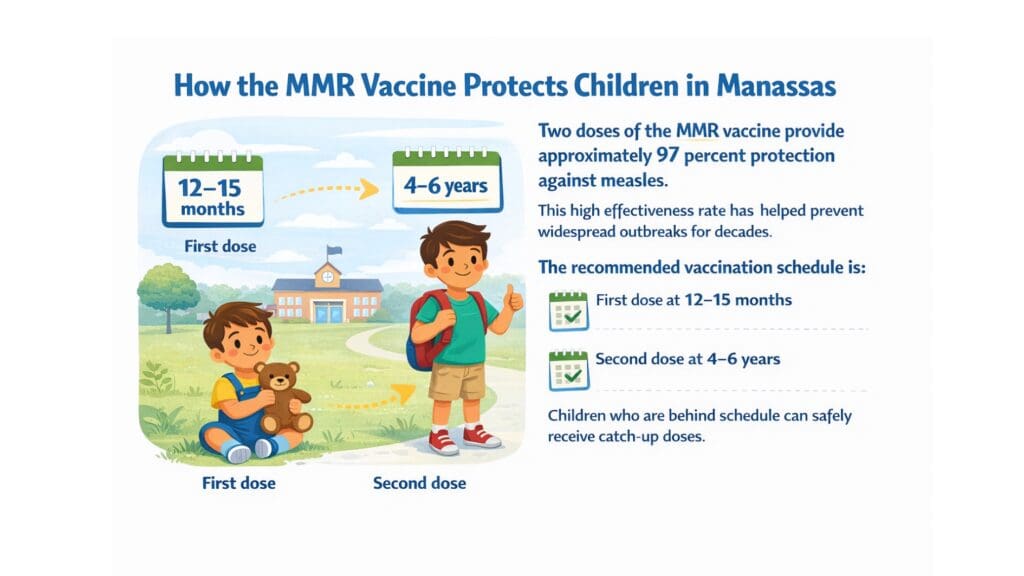
• One dose is approximately 93 percent effective
• Two doses are approximately 97 percent effective
That level of protection is considered extremely strong in preventive medicine. For most children who receive both recommended doses, immunity is long-lasting.
The standard schedule recommended by the CDC is:
• First dose between 12 and 15 months
• Second dose between 4 and 6 years
If your child has received both doses, they are highly protected. If you are unsure, this is the time to review records.
Is the Measles (MMR) Vaccine Safe for Children?
Safety is often the first concern for families in Winchester considering immunizations. The MMR vaccine is one of the most extensively studied vaccines in pediatric medicine.
Before approval, vaccines must pass through:
• Pre-clinical laboratory testing
• Phase 1, 2, and 3 clinical trials
• FDA review
• Ongoing post-licensure monitoring
Even after decades of use, safety monitoring continues through national reporting systems.
The vast majority of children tolerate the MMR vaccine without issue. When side effects occur, they are generally mild and short-lived, including:
• Temporary soreness at the injection site
• Low-grade fever
• Mild rash
Severe allergic reactions are extremely rare.
Extensive research has shown no association between the MMR vaccine and autism. Multiple international studies have confirmed its safety profile.
From a medical standpoint, the risk of measles infection — including complications like pneumonia or encephalitis — far outweighs the risk of vaccine side effects.
For families searching for the measles vaccine in Winchester VA, understanding the safety data can provide reassurance and confidence in your decision.
👉 Call today to schedule your child’s measles vaccine in Winchester.
Prevention remains far simpler than treatment.
CATEGORY
2/16/2026
POSTED
Sometimes the signs are subtle—a once-outgoing kid who’s now withdrawn, slipping grades, or comments like “nobody likes me.” At Night Watch Pediatric Urgent Care in Winchester, we help parents recognize when their child might need emotional support—and we make getting that support easy.
Introducing Emotional Wellness Visits
Our Emotional Wellness Visits are designed for children and teens ages 6–17 who may be experiencing self-esteem issues, social struggles, anxiety, or mood changes. No referral needed. No long wait for a specialist. Just compassionate, early support when your child needs it.
Signs Your Child Might Benefit
- Negative self-talk (“I’m stupid,” “I can’t do anything right”)
- Avoiding school, activities, or friends
- Changes in sleep, appetite, or energy
- Increased worry or tearfulness
- Difficulty making or keeping friends
How Our Wellness Visit Works
- Enrichly Assessment: Your child completes a quick, age-appropriate self-esteem screening
- Provider Check-In: We ask gentle questions about school, friendships, and feelings
- Confidence Builder Plan: Together, we set 2–3 achievable goals (like daily journaling or affirmations)
- 4-Week Follow-Up: We reassess and celebrate progress—or adjust the plan as needed
When More Support Is Needed
If our screening reveals concerns that need specialized care, we’ll connect you with trusted Winchester-area providers.
You’re Not Overreacting
Parents often wonder if they’re making too big a deal out of things. Trust your instincts. If something feels off with your child, it’s worth checking out. Our team will meet you with compassion—not judgment—and help your child build the confidence they deserve.
Catching it early can change everything.
Schedule an Emotional Wellness Visit at Night Watch – Winchester today
CATEGORY
11/26/2025