Mon - Fri 10am - 10pm
Sat- Sun 10am - 7pm
hello@nightwatchuc.com
2118 Pleasant Valley Road Winchester, VA 22601
(540) 545-9999


blog spot
The
Health hub
A collection of helpful articles & information to spread awareness through education from our staff to you

We’re proud to share an exciting milestone with our community.
Night Watch Pediatric & Adult Urgent Care in Stone Ridge has been recognized by BusinessRate as a Top Urgent Care Center in Loudoun County for 2026.

According to the recognition letter, this distinction is based on Google reviews and reflects verified customer feedback and publicly available review data.
For our team, that makes this recognition particularly meaningful because it reflects the voices and experiences of the people we serve.
A Recognition Made Possible by Our Patients
Every day, families trust Night Watch during moments they didn’t necessarily plan for.
It might be a child who develops a fever after their regular doctor’s office has closed, an unexpected sports injury, or an adult who needs care without waiting days for an appointment.
Whatever brings someone through our doors, our goal is to make sure they feel heard, supported, and cared for.
Every review and piece of feedback helps us continue working toward that goal.
Caring for Children and Adults in Stone Ridge
Our Stone Ridge location provides urgent care for both children and adults, giving families in Aldie, Stone Ridge, and surrounding Loudoun County communities another option for non-life-threatening illnesses and injuries.
With evening and weekend availability, we’re here for many of those health concerns that don’t conveniently happen during regular office hours.
Thank You, Loudoun County 💙
Recognition is always exciting, but this one belongs just as much to our community as it does to our team.
To every patient and family who has visited Night Watch, shared feedback, left a Google review, or recommended us to someone else, thank you for your trust.
And to our Stone Ridge team, thank you for the compassion, professionalism, and dedication you bring to our patients every day.
We’re grateful to be recognized as a Top Urgent Care Center in Loudoun County for 2026, and we look forward to continuing to serve our community for years to come.
CATEGORY
9/18/2026
POSTED
We’re proud to share an exciting milestone with our community.
Night Watch Pediatric & Adult Urgent Care in Stone Ridge has been recognized by BusinessRate as a Top Urgent Care Center in Loudoun County for 2026.
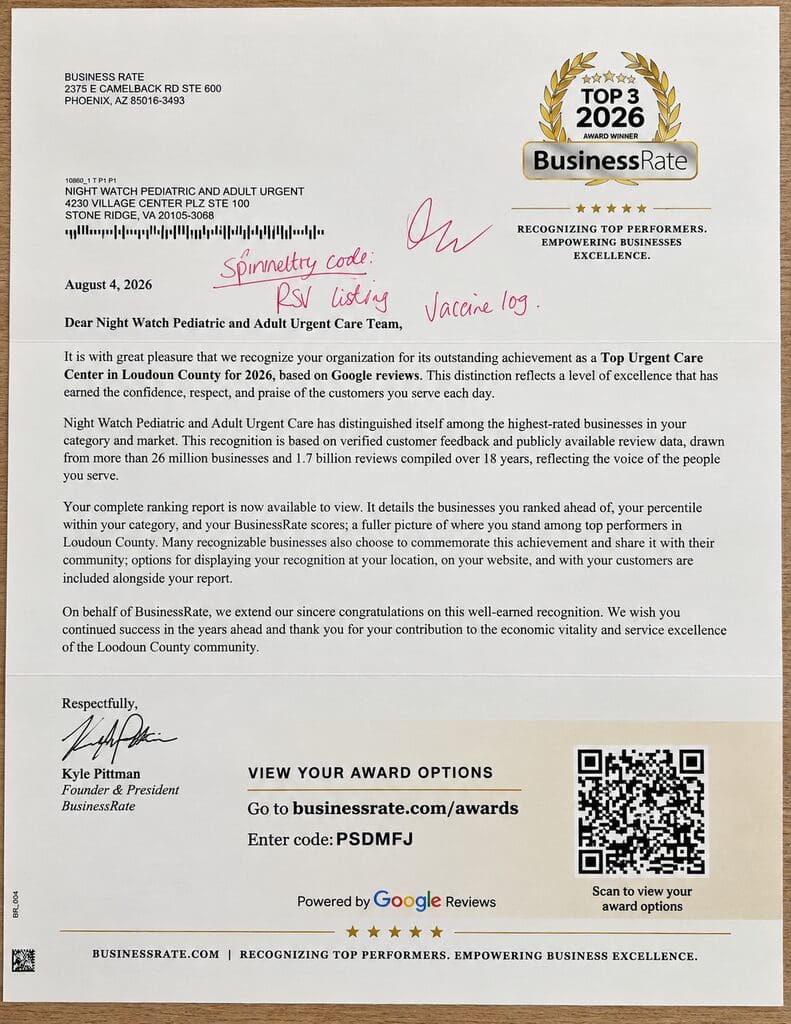
According to the recognition letter, this distinction is based on Google reviews and reflects verified customer feedback and publicly available review data.
For our team, that makes this recognition particularly meaningful because it reflects the voices and experiences of the people we serve.
A Recognition Made Possible by Our Patients
Every day, families trust Night Watch during moments they didn’t necessarily plan for.
It might be a child who develops a fever after their regular doctor’s office has closed, an unexpected sports injury, or an adult who needs care without waiting days for an appointment.
Whatever brings someone through our doors, our goal is to make sure they feel heard, supported, and cared for.
Every review and piece of feedback helps us continue working toward that goal.
Caring for Children and Adults in Stone Ridge
Our Stone Ridge location provides urgent care for both children and adults, giving families in Aldie, Stone Ridge, and surrounding Loudoun County communities another option for non-life-threatening illnesses and injuries.
With evening and weekend availability, we’re here for many of those health concerns that don’t conveniently happen during regular office hours.
Thank You, Loudoun County 💙
Recognition is always exciting, but this one belongs just as much to our community as it does to our team.
To every patient and family who has visited Night Watch, shared feedback, left a Google review, or recommended us to someone else, thank you for your trust.
And to our Stone Ridge team, thank you for the compassion, professionalism, and dedication you bring to our patients every day.
We’re grateful to be recognized as a Top Urgent Care Center in Loudoun County for 2026, and we look forward to continuing to serve our community for years to come.
CATEGORY
9/18/2026
POSTED
Sneezing, congestion, coughing, and a runny nose can all show up this fall. Here’s how to know what may be causing your child’s symptoms and how to prepare for the season ahead.
Fall brings cooler weather, school routines, outdoor activities, and unfortunately, plenty of sniffles.
For parents, one of the hardest parts is figuring out what those symptoms actually mean.
Is it seasonal allergies? A common cold? Flu? Something your child picked up at school?
While symptoms can overlap, there are a few clues that can help you decide what to do next.
Why Do Allergies Get Worse in the Fall?
Spring gets most of the attention when it comes to allergies, but fall can be difficult for children with seasonal allergies too.
Ragweed pollen is one of the major fall allergy triggers. Mold spores can also increase around damp leaves, soil, and other outdoor areas.
Children with fall allergies may experience:
→ Frequent sneezing
→ Clear or runny nose
→ Nasal congestion
→ Itchy or watery eyes
→ Itchy nose or throat
→ Postnasal drip
→ Mild coughing, especially from drainage
One useful clue is itchiness. An itchy nose, eyes, or throat is much more characteristic of allergies than many viral illnesses.
Allergy symptoms may also persist or return when your child is exposed to their triggers.
Allergies vs. a Cold: What Should Parents Look For?
A runny nose alone doesn’t always give you the answer.
With seasonal allergies, children commonly have clear nasal drainage, sneezing, itchy or watery eyes, and symptoms that follow exposure to allergens. Allergies themselves do not cause fever and aren’t contagious.
A viral respiratory infection may include congestion and coughing too, but your child may also develop fever, sore throat, fatigue, decreased appetite, or symptoms that change over several days.
And once school is back in session, children have plenty of opportunities to encounter respiratory viruses.
If you’re unsure which one you’re dealing with, especially when symptoms are worsening rather than improving, an evaluation can help.
What About the Flu?
Flu can look very different from a typical case of seasonal allergies.
Children with influenza may develop symptoms such as:
→ Fever or chills
→ Cough
→ Sore throat
→ Runny or stuffy nose
→ Headache or body aches
→ Significant tiredness
→ Vomiting or diarrhea, which can occur more commonly in children than adults
Unlike seasonal allergies, flu is caused by a virus and can spread from person to person.
That makes fall a good time to think beyond treating today’s sniffles and start preparing your family for the respiratory illness season ahead.
Fall Is a Good Time to Check Your Child’s Vaccines
Fall also means the start of another flu season, making this a good time to check whether your family is up to date on recommended vaccinations.
The CDC recommends annual flu vaccination for most people ages 6 months and older. Staying current on recommended vaccines can help protect your family as respiratory illnesses begin circulating more frequently during the fall and winter months.
Night Watch Urgent Care offers routine and seasonal vaccinations, making it easier to take care of this important fall health task.
Vaccine availability may vary, so call your nearest Night Watch location to confirm which vaccines are currently available before your visit.
Helping Your Child Through Fall Allergy Season
If allergies are the problem, reducing exposure can sometimes make the season more comfortable.
Try having children wash their hands and face after spending time outside, change clothes after heavy outdoor exposure, keep windows closed when pollen counts are high, and avoid letting piles of damp leaves accumulate around areas where children play.
Your child’s healthcare provider can also help you determine whether an age-appropriate allergy treatment may be useful.
When Should Your Child Be Seen?
Not every sniffle needs an urgent care visit. But it may be time for an evaluation if you’re unsure whether symptoms are allergies or an illness, symptoms continue to worsen, your child develops a persistent or high fever, they’re having difficulty eating or drinking, or they’re simply not acting like themselves.
Seek emergency care for significant difficulty breathing, blue or gray lips or skin, severe dehydration, or if your child is extremely difficult to wake.
We’re Here for the Unexpected Fall Sick Days
Whether it’s a cough that appeared overnight, a fever after school, worsening allergy symptoms, or you’re simply unsure what’s making your child sick, Night Watch Urgent Care is here to help.
CATEGORY
9/18/2026
POSTED
Save this before misinformation does the damage. Sexual health misinformation has a way of sticking around.
Even in 2026, myths about sexually transmitted infections (STIs), testing, symptoms, and transmission can influence whether someone gets screened, seeks treatment, or unknowingly exposes a partner.
The problem is that STIs do not always behave the way people expect. Many infections can cause few or no symptoms, and you cannot determine someone’s STI status based on how healthy they look or feel.
Here are five sexual health myths worth leaving behind.
Myth #1: “I’d know if I had an STI.”
Fact: You may have no symptoms at all.
This is one of the most important misconceptions about sexual health.
Many STIs can be asymptomatic, meaning an infection may be present without obvious symptoms. Chlamydia and gonorrhea, for example, frequently occur without noticeable symptoms.
Even when symptoms do occur, they may be mild enough to overlook or mistake for something else.
That means waiting for burning, discharge, sores, pain, or another obvious symptom is not a reliable way to know your status.
The takeaway: If you have a reason to be tested, feeling completely fine should not stop you from getting screened.
Myth #2: “You can catch an STI from a public toilet seat.”
Fact: Toilet seats are not a typical route of STI transmission.
This myth has been around for generations.
STIs are primarily transmitted through sexual contact, including vaginal, anal, or oral sex. Some infections can also spread through close skin-to-skin sexual contact or exposure to infected blood.
Sitting on a public toilet seat is not considered a realistic route of transmission for common STIs.
So while good hygiene in public bathrooms is always reasonable, the toilet seat is not where your attention should be focused when thinking about STI prevention.
The takeaway: Understanding how STIs actually spread helps you focus on the risks that matter.
Myth #3: “If my partner looks healthy, they probably don’t have an STI.”
Fact: You cannot tell someone’s STI status by looking at them.
No rash. No sores. No discharge. No complaints.
None of these proves that someone is STI-free.
Because many infections can remain asymptomatic, someone can feel healthy, look healthy, and still have an infection.
This is also why relying only on a partner to tell you whether they “feel fine” is not the same as knowing their testing status.
The takeaway: Testing gives you information that appearances cannot.
Myth #4: “If I’m in a relationship, I don’t need STI testing.”
Fact: Your need for screening depends on your individual circumstances and risk factors, not simply your relationship status.
Being in a relationship does not automatically answer questions about sexual health.
A new relationship can actually be an important time for partners to discuss previous testing, sexual history, protection, and whether screening makes sense.
Testing may also be appropriate after a new sexual partner, possible exposure, unprotected sex, or when recommended as part of routine preventive care.
The takeaway: STI testing is healthcare. It does not need to be treated as an accusation or a sign of distrust.
Myth #5: “If I don’t have symptoms, I can just wait.”
Fact: Delaying testing can allow some untreated infections to cause complications or be transmitted to others.
Some untreated STIs can eventually contribute to complications such as pelvic inflammatory disease and fertility problems. An infection can also be passed to another person even when symptoms are absent.
Knowing your status allows you and your healthcare provider to determine whether treatment, additional testing, or follow-up is needed.
Testing before symptoms appear can be exactly the point.
Sexual Health Should Be Based on Facts, Not Assumptions
There should be nothing embarrassing about wanting to know your STI status.
You do not need to wait until you have symptoms. You do not need to “look sick.” And you do not need to wait until you are certain something is wrong.
Testing can simply be part of taking care of your health.
At Night Watch Urgent Care – Stone Ridge, we offer confidential STI/STD testing for adults, including rapid testing options for certain infections.
Whether you have symptoms, a recent exposure, a new partner, or simply want clarity about your status, our team can help determine which tests are appropriate for you.
Night Watch Urgent Care – Stone Ridge / Aldie
42010 Village Center Plaza, Suite 100
Aldie, VA
(703) 775-4999
Walk-ins are welcome, or you can book a visit online.
Feeling fine is reassuring. Knowing your status gives you answers.
CATEGORY
9/04/2026
POSTED
As parents, we spend weeks preparing our children for a new school year. We buy backpacks, sharpen pencils, and check off school supply lists.
But there’s one important item many families forget:
Can your child actually see the board?
August is Children’s Eye Health and Safety Month, making it the perfect time to think about your child’s vision before school begins. Good eyesight plays a major role in learning, reading, sports, and everyday confidence. Many vision problems develop gradually, and children often don’t realize they’re seeing differently because it’s all they’ve ever known.
A simple vision screening during your child’s annual well visit can help identify concerns early.

Why Eye Health Matters
Nearly 80% of classroom learning is visual. Children rely on their eyesight to:
✔ Read books and worksheets
✔ See the classroom board
✔ Complete homework
✔ Participate in sports
✔ Develop hand-eye coordination
When vision problems go unnoticed, they can sometimes be mistaken for learning difficulties or attention problems.
Signs Your Child May Be Having Trouble Seeing
Children don’t always tell parents when something looks blurry.
Instead, you may notice they:
• Squint often
• Sit very close to the TV or tablet
• Hold books close to their face
• Rub their eyes frequently
• Complain of headaches after reading
• Lose their place while reading
• Avoid reading or homework
If you’ve noticed any of these signs, it’s worth mentioning them during your child’s next well visit.
Screen Time and Eye Strain
Today’s kids use screens for school, homework, entertainment, and staying connected with friends.
While screen time doesn’t usually cause permanent eye damage, it can lead to digital eye strain, leaving children with tired, dry, or uncomfortable eyes.
Simple habits can help:
✔ Encourage breaks every 20 minutes
✔ Remind your child to blink regularly
✔ Keep screens about 18–24 inches away
✔ Reduce glare when possible
✔ Adjust screen brightness to a comfortable level
Small changes can make a big difference, especially during the school year.
Vision Milestones by Age
Every child develops differently, but routine vision screenings help ensure healthy eye development.
Babies (Birth–12 Months)
Your pediatrician checks that your baby’s eyes are developing normally and that they can focus, track movement, and respond to light.
Toddlers and Preschoolers
As children grow, they’re developing depth perception, hand-eye coordination, color vision, and visual memory.
School-Age Children
Routine vision screenings become increasingly important as reading, writing, sports, and classroom learning place greater demands on their eyesight.
If a screening identifies concerns, your pediatrician may recommend a comprehensive eye exam with an eye specialist.
Why Well Visits Matter
Your child’s annual well visit is about much more than vaccines.
It’s also an opportunity to monitor growth, development, hearing, vision, and overall health before the school year begins.
If we notice anything unusual during your child’s vision screening, we’ll discuss the next steps and refer you to an eye specialist if needed.
Early detection gives children the best opportunity for healthy vision and successful learning.
Schedule Your Child’s Back-to-School Well Visit
Before the first school bell rings, make sure your child is ready to learn with confidence.
At KidsWatch Pediatrics, our well visits include:
✔ Vision screening
✔ Hearing screening
✔ Growth and development checks
✔ School forms
✔ Immunizations
One visit helps prepare your child for a healthy, successful school year.
CATEGORY
8/07/2026
POSTED
Summer is meant for splash pads, pool days, sports camps, cookouts, and family vacations. But it’s also the season when pediatricians and urgent care providers see an increase in preventable illnesses and injuries.
From dehydration and sunburns to tick bites and bike accidents, a few simple precautions can help keep your child healthy all summer long.
Here’s what our pediatric team recommends.
Stay Ahead of Heat Illness
Children heat up faster than adults, making them more susceptible to dehydration and heat exhaustion during outdoor play.
Help prevent heat-related illness by:
✔ Offering water every 20–30 minutes during outdoor activities, even if your child isn’t thirsty.
✔ Scheduling outdoor play in the morning or evening when temperatures are cooler.
✔ Taking frequent breaks in the shade or air conditioning.
Watch for early signs of heat exhaustion, including:
• Excessive sweating
• Headache
• Dizziness
• Fatigue
• Nausea
• Pale or clammy skin
If your child becomes confused, stops sweating despite the heat, loses consciousness, or has a temperature above 104°F, seek emergency medical care immediately. (Hopkins Medicine)
Protect Their Skin from the Sun
A painful sunburn can happen faster than many parents realize, even on cloudy days.
To reduce your child’s risk:
✔ Apply a broad-spectrum sunscreen with SPF 30 or higher about 15–30 minutes before going outside.
✔ Reapply every two hours, or sooner after swimming or heavy sweating.
✔ Encourage hats, sunglasses, and lightweight protective clothing.
✔ Whenever possible, seek shade during the strongest sun hours, typically between 10 a.m. and 4 p.m. (Premier Medical Group)
Water Safety Is More Than Knowing How to Swim
Whether you’re visiting a neighborhood pool, lake, or beach, active supervision is the most important safety measure.
Remember to:
✔ Keep young children within arm’s reach in or near water.
✔ Never rely solely on flotation devices.
✔ Choose U.S. Coast Guard-approved life jackets for boating.
✔ Designate one adult as the “water watcher” without distractions from phones or conversations.
Drowning can happen quickly and quietly, making constant supervision essential. (Hopkins Medicine)
Don’t Forget Helmets
Bikes, scooters, skateboards, and rollerblades are part of summer fun, but they’re also common reasons children visit urgent care.
Help prevent serious injuries by:
✔ Wearing a properly fitted helmet every ride.
✔ Using knee and elbow pads when appropriate.
✔ Riding in safe areas away from traffic.
✔ Checking equipment regularly for loose parts or damage.
Keep an Eye Out for Ticks and Mosquitoes
Northern Virginia’s wooded parks and hiking trails are beautiful during the summer, but they’re also home to ticks and mosquitoes.
To lower your child’s risk:
✔ Use an EPA-registered insect repellent appropriate for your child’s age.
✔ Wear long sleeves and pants when hiking in wooded or grassy areas.
✔ Perform a full tick check after outdoor activities.
✔ Remove ticks promptly with fine-tipped tweezers if found.
Practice Safe Summer Eating
Picnics, barbecues, and fresh produce are summer favorites, but foodborne illnesses also become more common this time of year.
Help keep your family safe by:
✔ Washing fruits and vegetables thoroughly.
✔ Keeping cold foods cold and hot foods hot.
✔ Avoiding foods that have been left out for extended periods.
✔ Washing hands before eating and preparing meals.
Be Prepared for Allergies and Insect Stings
If your child has food allergies or a history of severe allergic reactions:
✔ Always carry their prescribed emergency medication.
✔ Make sure caregivers, camp counselors, and relatives know how to recognize an allergic reaction.
✔ Have an action plan before heading to camps, parties, or outdoor events.
Know When to Visit Urgent Care
Many summer illnesses and injuries can be evaluated without a trip to the emergency room.
Visit Night Watch Urgent Care or KidsWatch Pediatrics for:
→ Minor cuts that may need stitches
→ Sprains and suspected minor fractures
→ Tick bites
→ Mild dehydration
→ Sunburn
→ Ear infections after swimming
→ Rashes and insect bites
→ Vomiting or diarrhea without severe dehydration
Always call 911 or go to the nearest emergency department for difficulty breathing, seizures, loss of consciousness, severe allergic reactions, or major injuries.
Enjoy a Safe and Healthy Summer
A little preparation goes a long way toward preventing common summer illnesses and injuries.
If your child needs care this summer, our team is here seven days a week with walk-in appointments, pediatric expertise, and convenient care when you need it most.
Stay safe, stay hydrated, and enjoy everything summer in Northern Virginia has to offer!
CATEGORY
7/23/2026