Mon - Fri 10am - 10pm
Sat- Sun 10am - 7pm
hello@nightwatchuc.com
2118 Pleasant Valley Road Winchester, VA 22601
(540) 545-9999


blog spot
The
Health hub
A collection of helpful articles & information to spread awareness through education from our staff to you

Every summer, when the heat index in Northern Virginia climbs into the triple digits, we see a predictable shift in what walks through our doors. Heat-related illness is not dramatic the way a broken bone is. It creeps up quietly. And by the time most families come in, they have already been dealing with symptoms for hours.
This is what we actually see during heat waves — and more importantly, what you can do to avoid becoming one of those visits.
Dehydration
This is by far the most common thing we treat during heat waves. And almost every family that comes in says the same thing: they thought their child was drinking enough.
Here is the problem. Thirst is one of the last signs of dehydration. By the time a child asks for water, their body has already been running low for a while. And in summer heat, especially during outdoor sports or play, kids lose fluids faster than they are replacing them without even realizing it.
What we see in the clinic: children who are tired beyond what the day explains, have a headache that will not go away, are unusually irritable, have not urinated in several hours, or have dry lips and sunken eyes. In more significant cases we see rapid heart rate and dizziness that gets worse when standing.
What we do: for mild dehydration we guide families through oral rehydration. For moderate cases, we offer IV hydration therapy on site, which replenishes fluids and electrolytes directly and gets kids feeling better significantly faster than drinking alone.
How to avoid it: hydrate before you go outside, not when your child is already thirsty. Offer fluids every 20 minutes during outdoor activity. Water is best. Avoid juice, sports drinks with high sugar content, and energy drinks entirely for children.
Heat Exhaustion
Heat exhaustion is what happens when dehydration and heat exposure combine and the body starts to struggle with temperature regulation. It is a step beyond simple dehydration and a step before heat stroke, which is the emergency.
What we see in the clinic: children who look pale and feel clammy, are sweating heavily, feel weak or nauseated, have a headache, and sometimes feel faint or dizzy. Parents often describe a child who came inside from playing and just collapsed on the couch and could not get up.
What we do: we assess vital signs, check for signs of heat stroke, support cooling, and rehydrate. Most cases of heat exhaustion resolve well with prompt care. The ones that do not get better quickly are the ones we monitor more carefully for progression to heat stroke.
How to avoid it: shade breaks matter more than most parents realize. Even if a child seems fine, bring them indoors or into shade every 30 to 45 minutes during intense outdoor activity in heat. Dress kids in light, loose, breathable fabrics. Limit vigorous outdoor activity to early morning or after 5pm when the heat index has dropped.
Heat Stroke
Heat stroke is a medical emergency and the one condition on this list where we will always tell you to call 911 first. We include it here because families need to recognize it before it gets to that point.
What distinguishes heat stroke from heat exhaustion is that the body has lost the ability to cool itself. The child stops sweating despite being overheated. The skin becomes hot, red, and dry. They may become confused, disoriented, or difficult to rouse. Temperature is very high.
If you see these signs, do not drive to urgent care. Call 911. Apply cool wet cloths to the neck, armpits, and groin while you wait for emergency services. Do not give fluids to a child who is confused or unresponsive.
How to avoid it: never leave a child in a parked car under any circumstances. Recognize heat exhaustion early and treat it promptly before it progresses. Know that children, elderly people, and those with certain medical conditions are at the highest risk.
Sunburn and Sun Poisoning
Minor sunburn is something families handle at home. What comes to urgent care is the kind of sunburn that crosses into sun poisoning, and the difference is more significant than most people realize.
What we see in the clinic: children with significant blistering, chills, fever, nausea, headache, and dizziness alongside the burn. Sun poisoning is the body’s systemic inflammatory response to severe UV exposure and it needs medical evaluation.
What we do: we assess the extent of the burn, manage dehydration which almost always accompanies sun poisoning, treat pain, and guide wound care for significant blistering.
How to avoid it: apply SPF 30 or higher mineral-based sunscreen 20 minutes before going outside and reapply every two hours and immediately after swimming or sweating. Do not rely on a single morning application for an all-day outdoor event. Reapplication is where most families fall short.
Swimmer’s Ear
Pool season and heat waves overlap, which means swimmer’s ear spikes every time temperatures climb and kids spend more time in the water.
What we see in the clinic: children with ear pain that is worse when you pull on the outer ear, sometimes with discharge, and often with a history of multiple days in the pool or lake. Swimmer’s ear is an infection of the outer ear canal caused by water that stays trapped and creates a warm moist environment for bacterial growth.
What we do: we diagnose it on site and prescribe antibiotic ear drops. Most cases resolve well with prompt treatment. The ones that wait too long are the ones that become significantly more painful and take longer to heal.
How to avoid it: tip each ear down and gently pull the earlobe after swimming to help water drain. Dry ears gently with a towel but do not insert cotton swabs into the ear canal. Swim plugs can help for children who are in the pool daily.
Heat Rash
Heat rash is not dangerous but it is extremely common during heat waves and we see it constantly this time of year.
What it looks like: small red or pink bumps, usually in areas where skin touches skin or where clothing sits tight. Common spots include the neck, chest, groin, and under the arms. It appears when sweat glands become blocked and sweat cannot escape properly.
What we do: for most cases we confirm the diagnosis, rule out other causes, and guide families on management at home. For cases where heat rash has become infected or is not improving, we treat accordingly.
How to avoid it: dress children in loose lightweight breathable fabrics. Keep them cool. Rinse off sweat after outdoor activity and pat skin dry. Avoid heavy creams or ointments that block the skin during hot weather.
When to Come In vs When to Manage at Home
Come in to Night Watch if your child:
👉 Cannot keep fluids down and shows signs of dehydration
👉 Has a headache, dizziness, or weakness after being in the heat
👉 Has a sunburn with blistering, fever, chills, or nausea
👉 Has ear pain after pool time
👉 Has a rash that is spreading, painful, or not improving
Call 911 if your child:
👉 Stops sweating despite being overheated
👉 Has skin that is hot, red, and dry
👉 Is confused, disoriented, or difficult to wake
👉 Has a very high body temperature
We Are Here When Heat Waves Hit
Night Watch Urgent Care is open late every weekday and every weekend across all three Northern Virginia locations. During heat waves we see a significant increase in visits and we are prepared for it.
Walk in anytime. No appointment needed.
CATEGORY
7/12/2026
POSTED
Fall sports tryouts feel far away in June. They are not. And every year, the same thing happens. Parents wait until the last week of August to schedule a sports physical, only to find that every pediatrician in Northern Virginia is booked solid and every urgent care has a line out the door.
We want to help you avoid that this year.
What Is a Sports Physical?
A sports physical, sometimes called a pre-participation physical evaluation, is a comprehensive examination designed to make sure your child is healthy and ready to safely participate in organized sports.
It is required by most schools, camps, and athletic leagues across Virginia before a child can join a team, attend tryouts, or step onto the field for the season.
At Night Watch, our sports physicals are built around one goal: confirming your child is ready, without the wait or the runaround that comes with scheduling through a typical pediatrician’s office.
Why Timing Matters
Most schools and athletic programs require a sports physical to be completed within a certain window before the season starts, often anywhere from a few months to a year, depending on the sport and the district.
The problem is that everyone tends to wait until the same time. Late summer becomes a bottleneck. Pediatrician offices get backed up. Forms do not get signed in time. Kids miss the first few days of practice, or worse, get held out of tryouts altogether.
Coming in during June or July, while the season feels far off, means you get seen quickly and walk out with the form completed, no stress, no scrambling.
What Happens During the Visit
When you walk in for a sports physical at Night Watch, our provider will review your child’s medical history, including any past injuries, surgeries, or family health conditions that could be relevant to athletic participation.
From there, the physical exam typically includes a general health assessment to make sure your child is cleared for the physical demands of their sport.
Our goal is to be thorough without making the visit feel like a hurdle. We want your child walking out the door cleared and confident, not anxious about whether they passed some kind of test.
No Appointment Needed
This is one of the biggest differences between Night Watch and a traditional pediatrician’s office. You do not need to schedule weeks in advance. You do not need to take a half day off work for an 11am slot that was the only one available.
Walk in any day at any of our three Northern Virginia locations. We will get your child seen, evaluated, and on their way with a completed form, same visit.
Whether It Is For
| A fall sports try out A summer camp that requires a physical before drop-off A travel team with a registration deadline Any organized activity that asks for medical clearance before participation |
If your child needs the form filled out, we can help.
Why Families Choose Night Watch for This
We know plenty of families in Northern Virginia who have a long-standing relationship with their pediatrician and prefer to handle physicals there when there is time to plan ahead. We respect that completely.
But for families who are short on time, dealing with a tight deadline, or just need it done without the back-and-forth of scheduling, Night Watch is built for exactly that moment. Extended hours, walk-in access, and a team that treats your child like one of our own.
Do Not Wait Until the Rush
Here is our honest advice. If your child plays a fall sport, needs a camp physical, or is joining a new team this year, come in now while the season still feels far away. You will thank yourself in August when everyone else is scrambling and your form is already done.
Walk in any day. No appointment needed. We are open late every weekday and every weekend across all three Northern Virginia locations.
CATEGORY
6/18/2026
POSTED
For the past seven years, Night Watch Urgent Care has been proud to serve families across Northern Virginia by providing trusted pediatric urgent care when children need it most.
What began as a mission to make healthcare more accessible for families has grown into a reliable resource for parents looking for evening and weekend pediatric care outside traditional office hours.
Over the years, our clinics have helped thousands of families navigate everything from late-night fevers and sudden illnesses to minor injuries and unexpected health concerns.

Supporting Families When It Matters Most
Children rarely get sick at convenient times. Many parents find themselves searching for urgent care for kids near them late at night or on weekends when their pediatrician’s office is closed.
That is exactly why Night Watch Urgent Care exists.
Our team provides accessible pediatric urgent care services, helping families receive timely medical attention without the long wait times often associated with emergency rooms.
Common reasons families visit our clinics include:
• Fevers and viral illnesses
• Ear infections
• Cough, wheezing, and breathing concerns
• Minor injuries and fractures
• Rashes and allergic reactions
• Vomiting and dehydration
• Concussions and head injuries
Every visit is an opportunity to provide reassurance, answers, and compassionate care for both children and parents.
Pediatric Care That Focuses on Families
At Night Watch Urgent Care, pediatric care goes beyond treating symptoms. We focus on creating an environment where children feel comfortable and parents feel supported.
Our providers understand that when a child is sick, families need more than just medical treatment. They need guidance, clear communication, and confidence that they are making the right decisions for their child’s health.
For the past seven years, families have trusted our team to provide that care, and we are deeply grateful for the opportunity to serve our community.
Thank You for Trusting Us
Reaching this seven-year milestone would not have been possible without the families who have chosen Night Watch Urgent Care for their children’s healthcare needs.
We are incredibly thankful to the parents, caregivers, and children who have walked through our doors, called us for guidance, or trusted us during difficult moments.
Serving this community is an honor, and we look forward to continuing to support the health and well-being of families for many years to come.
Pediatric Urgent Care When You Need It
Night Watch Urgent Care provides convenient pediatric urgent care with evening and weekend availability, making it easier for families to get care when traditional offices are closed.
Walk-ins are welcome.
Stone Ridge (Aldie, VA)
42010 Village Center Plaza, Ste 100
(703) 775-4999
Winchester, VA
2118 Pleasant Valley Rd
(540) 545-9999
Manassas, VA
11700 Sudley Manor Dr
(703) 589-9695
If you are searching for pediatric urgent care near you, our team is here to help.
Share Your Experience
If Night Watch Urgent Care has cared for your family over the years, we would love to hear your story. Your feedback helps us continue improving and supporting families across our community.
Thank you for being part of our journey.
CATEGORY
3/10/2026
POSTED
How to Prevent Dehydration and Know When to Seek Care
A stomach bug, also called gastroenteritis, is a common illness that causes vomiting, diarrhea, stomach cramps, and sometimes fever. It’s usually caused by a virus and typically lasts a few days.
Most children recover at home with rest and fluids. The biggest concern isn’t the virus itself — it’s dehydration from fluid loss.
Top Things to Know
- Stomach bugs cause vomiting and diarrhea, which can lead to fluid loss.
- Dehydration is the main risk in children.
- Most kids improve within a few days with proper hydration.
- Small, frequent fluids work better than large amounts at once.
- Severe dehydration requires medical care.
Signs & Symptoms
What Are the Signs of a Stomach Bug?
The most common symptoms include:
- Vomiting
- Diarrhea
- Nausea
- Belly cramps
- Fever
- Headache
- Fatigue
- Muscle aches
When kids vomit or have diarrhea, they lose fluids quickly. If those fluids aren’t replaced, dehydration can develop.

Why Hydration Matters
Dehydration happens when the body doesn’t have enough fluids to function properly. Young children are especially vulnerable because their bodies are smaller and lose fluids faster.
Early hydration helps:
- Prevent ER visits
- Shorten recovery time
- Reduce weakness and dizziness
- Lower complication risk
The goal is to replace fluids steadily — not all at once.
Treatment & Home Care
How Can I Keep My Child Hydrated?
If your child has mild symptoms, you can usually manage care at home.
Offer Small Amounts Frequently
Give small sips every 5–10 minutes. Large drinks can trigger more vomiting.
Use Oral Rehydration Solutions
Electrolyte drinks made for children replace fluids and salts lost through vomiting and diarrhea. Water alone may not be enough.
Try Frozen Options
Electrolyte popsicles or ice chips can be easier for some kids to tolerate.
Resume Food Slowly
Once vomiting improves, start with bland foods like toast, rice, applesauce, or crackers. Avoid fatty or greasy foods.
Avoid Sugary Drinks
Juice, soda, and sports drinks can worsen diarrhea.
Signs of Dehydration
Call your provider or seek evaluation if your child has:
- Very dry mouth or cracked lips
- No tears when crying
- Fewer wet diapers or bathroom trips
- Dark yellow urine
- Unusual sleepiness or low energy
- Dizziness or weakness
For babies, fewer than three wet diapers in 24 hours is concerning.
When Should I Seek Care Right Away?
Seek urgent medical attention if your child:
- Cannot keep fluids down
- Has blood in vomit or stool
- Has severe abdominal pain
- Shows signs of significant dehydration
- Has a high fever that doesn’t improve
- Is difficult to wake or unusually confused
If you’re unsure whether it’s serious, it’s always safer to have your child evaluated.
If you’re in Winchester and wondering whether your child’s stomach bug requires medical attention, our urgent care team can provide prompt evaluation. Many families search for Winchester urgent care for vomiting and diarrhea in kids — and we’re equipped to assess dehydration and offer supportive treatment quickly.
Early care can prevent complications and help your child recover faster.
📍 2118 Pleasant Valley Road
📞 (540) 545-9999
CATEGORY
3/01/2026
POSTED
When your child is sick or hurt, the best place to go depends on two things: how severe the symptoms are and how fast your child needs to be evaluated. If you’re seeing emergency warning signs (trouble breathing, severe allergic reaction, seizure, or a child who is hard to wake), skip the debate and go straight to the ER or call your local emergency number.
Below is a practical, parent-friendly guide to help you decide.
Choose the ER if your child may be in danger right now or could worsen quickly.
Choose Urgent Care if your child needs same-day evaluation for a non-life-threatening problem (especially when your pediatrician is closed or can’t see you soon).
Choose the Pediatrician for routine care, ongoing concerns, and problems that can safely wait for an office visit.
If you’re unsure, many urgent care clinics also offer telemedicine or nurse/triage guidance—but if your gut says “this is an emergency,” trust that and go to the ER.
Go to the ER now (or call emergency services) if…
These are red-flag symptoms that should be treated as emergencies:
- Trouble breathing, fast breathing, ribs pulling in with breaths, blue/gray lips or face.
- Severe allergic reaction: facial/lip/tongue swelling, trouble breathing, widespread hives with vomiting or dizziness.
- Seizure, fainting, or your child is very hard to wake/confused.
- Head injury with loss of consciousness, repeated vomiting, worsening headache, or unusual behavior.
- Severe bleeding that won’t stop with firm pressure.
- Suspected broken bone with deformity (bone looks out of place), severe pain, or numbness/tingling.
- Severe dehydration: no urine for 8–12 hours, very dry mouth, no tears, lethargy, or sunken eyes (especially in babies).
- Fever in a baby under 3 months (or any infant who looks very ill).
- Poisoning/ingestion (medications, chemicals, unknown substances), or concern for overdose.
- Severe abdominal pain, especially with a hard belly, persistent vomiting, or pain in the lower right abdomen.
- Any situation where you feel your child is not safe to wait.
Urgent Care is usually best for…
Urgent care is a strong option when your child needs prompt care but is stable.
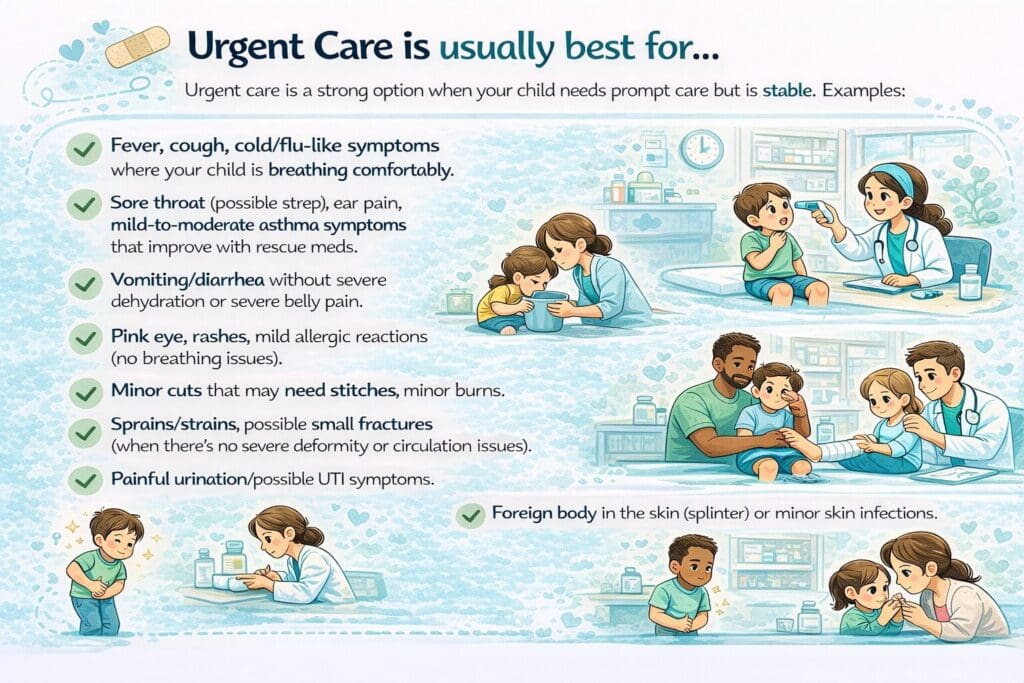
Why parents choose urgent care: Urgent care is a go-to option when you need your child seen the same day but your pediatrician is fully booked. Many urgent care clinics can also provide on-site testing, like rapid strep, flu, or COVID tests, and may offer X-rays, which can speed up answers and treatment decisions. It’s also especially helpful during evenings and weekends when your pediatrician’s office is closed, so you’re not forced to wait until the next business day.
Your Pediatrician is best for… Your child’s pediatrician should be your home base for routine and long-term care, including well visits, vaccines, and growth and developmental check-ins. They’re also the best fit for ongoing or recurring concerns, like asthma management plans, eczema, constipation, and repeated ear infections, because they can follow patterns over time and adjust care as your child grows. Pediatricians are ideal for behavior and sleep concerns, school-related issues, anxiety, and ADHD evaluations, and they’re a great choice when symptoms are mild, improving, and safe to wait for an appointment. They should also handle follow-ups after urgent care or ER visits to make sure your child is recovering well and to coordinate next steps if anything needs closer monitoring. Why it matters: your pediatrician knows your child’s history, tracks progress across multiple visits, and can coordinate referrals to specialists when needed.
Common scenarios (where to go)
1) Ear pain + low fever
- Usually urgent care or pediatrician (same/next day).
- ER only if severe swelling behind the ear, stiff neck, extreme lethargy, or severe dehydration.
2) Sore throat + fever
- Urgent care or pediatrician for strep testing and guidance.
- ER if trouble breathing, drooling with inability to swallow, or signs of dehydration.
3) Asthma/wheezing
- Urgent care if mild–moderate and improving with rescue inhaler.
- ER if your child is struggling to breathe, can’t speak in full sentences (age-appropriate), lips look bluish, or rescue meds aren’t helping.
4) Cut on the face
- Urgent care is often ideal, especially if it needs stitches and it’s within a few hours of the injury.
- ER if bleeding won’t stop, the wound is deep with visible fat/muscle, or there’s concern for a head injury.
5) Head bump after a fall
- Urgent care if your child is acting normal and symptoms are mild.
- ER for loss of consciousness, repeated vomiting, worsening headache, confusion, seizure, or very abnormal sleepiness.
If you’re stuck between urgent care and the ER, choose the safer option—especially for breathing problems, dehydration, head injuries, or very young infants. And if you’re deciding between urgent care and the pediatrician, urgent care makes sense when you can’t get a timely appointment or symptoms are worsening.
For same-day urgent care in Winchester, come to 2118 Pleasant Valley Road, Winchester, VA 22601, or call (540) 545-9999 and we’ll help you decide whether you should come in or use a virtual visit.
CATEGORY
2/22/2026