Mon - Fri 10am - 10pm
Sat- Sun 10am - 7pm
hello@nightwatchuc.com
2118 Pleasant Valley Road Winchester, VA 22601
(540) 545-9999


blog spot
The
Health hub
A collection of helpful articles & information to spread awareness through education from our staff to you

Night Watch Urgent Care | Pediatric Health Blog | June 2026 Locations: Manassas | Winchester | Aldie / Stone Ridge, Northern Virginia
Summer sports season is here. And with it comes the inevitable sprains, twists, and falls that every active kid experiences at some point.
When your child gets hurt on the field or the court, the first few minutes matter. Knowing what to do — and what not to do — can make a real difference in how quickly they recover and whether a small injury turns into a bigger problem.
The RICE method is the first thing every sports parent should know.

What Is the RICE Method?
RICE stands for Rest, Ice, Compression, and Elevation. It is the standard first response for soft tissue injuries like sprains, strains, and minor swelling in kids and adults.
It is not a replacement for medical evaluation. It is what you do in the first hour while you figure out whether your child needs to be seen.
R: Rest
The moment your child gets hurt, stop the activity.
This sounds obvious, but it is one of the steps parents and coaches most often skip. Kids want to keep playing. Coaches do not want to pull a key player. And in the heat of a game or practice, it is easy to convince yourself that walking it off will help.
It will not.
Continuing to put stress on an injured joint or muscle increases swelling, can turn a minor injury into a more serious one, and in kids, risks damage to growth plates that can affect long-term bone development.
When in doubt, sit them out. No game is worth a serious injury.
I: Ice
Ice reduces swelling and numbs pain. Used correctly, it is one of the most effective tools in the first 24 to 48 hours after an injury.
Used incorrectly, it can make things worse.
The most common mistake parents make is pressing an ice pack directly onto the skin. This can cause ice burns, damage the surface skin, and actually restrict blood flow in a way that slows healing down.
Always wrap the ice pack in a cloth or towel before applying it.
Apply for 15 to 20 minutes at a time. Then remove it for at least 20 minutes before reapplying. Repeat this cycle for the first few hours after the injury.
Never leave ice on while your child is sleeping, distracted, or unable to tell you if it is too cold.
C: Compression
Wrapping the injured area with an elastic bandage helps control swelling and provides gentle support to the joint.
The wrap should be snug but not tight. You should be able to slip two fingers underneath it. If the skin around the bandage looks pale, feels numb, or your child says it is tingling, the wrap is too tight. Loosen it immediately.
For ankle injuries, wrap from the toes upward. This helps prevent fluid from pooling in the foot below the injury site.
E: Elevation
Raising the injured limb above the level of the heart uses gravity to reduce swelling and improve circulation away from the injury site.
For a leg or ankle injury, have your child lie down and prop the leg up on a pillow or two. For a wrist or arm injury, keep the arm raised above shoulder height as much as possible.
The more consistently you can maintain elevation in the first few hours, the more effectively you will control swelling.
What RICE Does Not Tell You
RICE is a first response. It is not a diagnosis.
Here is what most parents do not know heading into summer sports season. A sprain and a fracture can feel exactly the same in the first hour after an injury. Both cause pain. Both cause swelling. Both cause bruising. Your child may be able to put some weight on a fractured bone. And a bad sprain can be just as painful as a break.
In children, the situation is even more nuanced. Kids have growth plates near the ends of their developing bones. These are areas of softer, cartilage-like tissue that are more vulnerable to injury than the hardened bone of adults. A force that would cause a sprain in an adult can sometimes fracture a growth plate in a child.
Growth plate injuries that go undiagnosed and untreated can affect how the bone develops long term.
The only way to know whether you are dealing with a sprain or a fracture is an X-ray.
When to Come In
Start RICE right away. Then assess how your child is doing over the next 30 to 60 minutes.
Come in to Night Watch if you notice any of the following.
The swelling is getting worse instead of better after an hour of RICE. Your child cannot put weight on the injured area at all. The joint looks different from normal or something appears out of place. Your child heard or felt a pop at the moment of injury. The pain is severe and not improving. Something just does not feel right.
That last one matters. You know your child. If your gut is telling you something is wrong, come in.
What Happens When You Walk In to Night Watch
When you bring your child in after a sports injury, here is what to expect.
Our team will evaluate the injury, ask about how it happened, and assess range of motion, swelling, and point tenderness. If we have any concern about a fracture or growth plate involvement, we will take an X-ray right here on site.
You will have a clear answer and a treatment plan before you leave. No separate radiology trip. No waiting days for results.
All three Night Watch locations have on-site X-ray available. No appointment needed. Walk in anytime.
This blog post is for educational purposes only and is not medical advice. Every child is different. If you have concerns about your child, please consult with a qualified healthcare provider.
CATEGORY
6/14/2026
POSTED
When your child is sick or hurt, the best place to go depends on two things: how severe the symptoms are and how fast your child needs to be evaluated. If you’re seeing emergency warning signs (trouble breathing, severe allergic reaction, seizure, or a child who is hard to wake), skip the debate and go straight to the ER or call your local emergency number.
Below is a practical, parent-friendly guide to help you decide.
Choose the ER if your child may be in danger right now or could worsen quickly.
Choose Urgent Care if your child needs same-day evaluation for a non-life-threatening problem (especially when your pediatrician is closed or can’t see you soon).
Choose the Pediatrician for routine care, ongoing concerns, and problems that can safely wait for an office visit.
If you’re unsure, many urgent care clinics also offer telemedicine or nurse/triage guidance—but if your gut says “this is an emergency,” trust that and go to the ER.
Go to the ER now (or call emergency services) if…
These are red-flag symptoms that should be treated as emergencies:
- Trouble breathing, fast breathing, ribs pulling in with breaths, blue/gray lips or face.
- Severe allergic reaction: facial/lip/tongue swelling, trouble breathing, widespread hives with vomiting or dizziness.
- Seizure, fainting, or your child is very hard to wake/confused.
- Head injury with loss of consciousness, repeated vomiting, worsening headache, or unusual behavior.
- Severe bleeding that won’t stop with firm pressure.
- Suspected broken bone with deformity (bone looks out of place), severe pain, or numbness/tingling.
- Severe dehydration: no urine for 8–12 hours, very dry mouth, no tears, lethargy, or sunken eyes (especially in babies).
- Fever in a baby under 3 months (or any infant who looks very ill).
- Poisoning/ingestion (medications, chemicals, unknown substances), or concern for overdose.
- Severe abdominal pain, especially with a hard belly, persistent vomiting, or pain in the lower right abdomen.
- Any situation where you feel your child is not safe to wait.
Urgent Care is usually best for…
Urgent care is a strong option when your child needs prompt care but is stable.
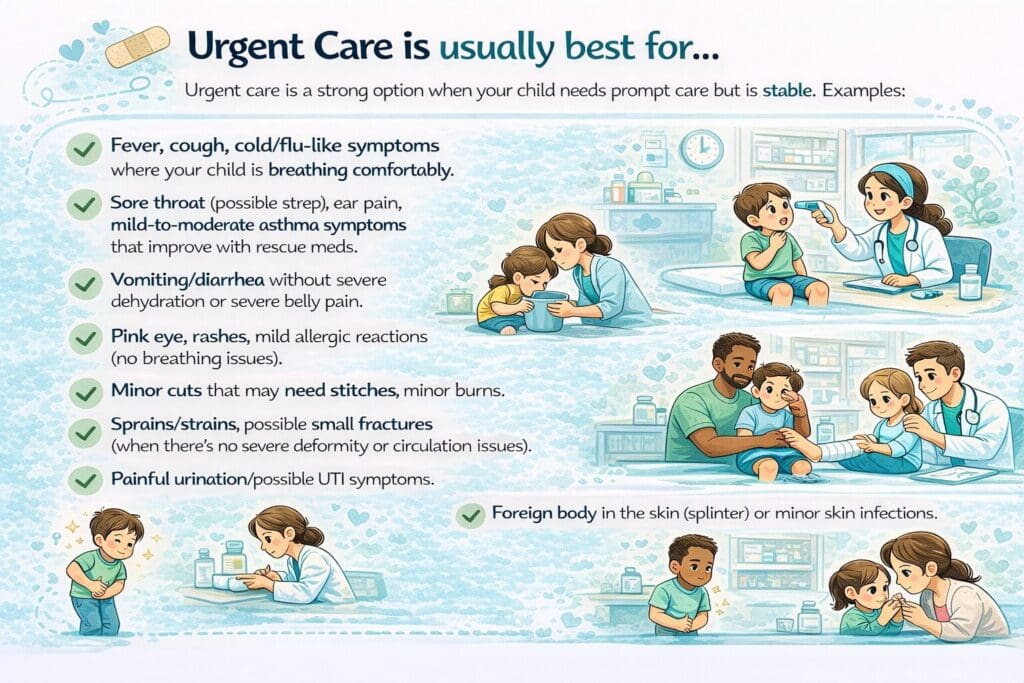
Why parents choose urgent care: Urgent care is a go-to option when you need your child seen the same day but your pediatrician is fully booked. Many urgent care clinics can also provide on-site testing, like rapid strep, flu, or COVID tests, and may offer X-rays, which can speed up answers and treatment decisions. It’s also especially helpful during evenings and weekends when your pediatrician’s office is closed, so you’re not forced to wait until the next business day.
Your Pediatrician is best for… Your child’s pediatrician should be your home base for routine and long-term care, including well visits, vaccines, and growth and developmental check-ins. They’re also the best fit for ongoing or recurring concerns, like asthma management plans, eczema, constipation, and repeated ear infections, because they can follow patterns over time and adjust care as your child grows. Pediatricians are ideal for behavior and sleep concerns, school-related issues, anxiety, and ADHD evaluations, and they’re a great choice when symptoms are mild, improving, and safe to wait for an appointment. They should also handle follow-ups after urgent care or ER visits to make sure your child is recovering well and to coordinate next steps if anything needs closer monitoring. Why it matters: your pediatrician knows your child’s history, tracks progress across multiple visits, and can coordinate referrals to specialists when needed.
Common scenarios (where to go)
1) Ear pain + low fever
- Usually urgent care or pediatrician (same/next day).
- ER only if severe swelling behind the ear, stiff neck, extreme lethargy, or severe dehydration.
2) Sore throat + fever
- Urgent care or pediatrician for strep testing and guidance.
- ER if trouble breathing, drooling with inability to swallow, or signs of dehydration.
3) Asthma/wheezing
- Urgent care if mild–moderate and improving with rescue inhaler.
- ER if your child is struggling to breathe, can’t speak in full sentences (age-appropriate), lips look bluish, or rescue meds aren’t helping.
4) Cut on the face
- Urgent care is often ideal, especially if it needs stitches and it’s within a few hours of the injury.
- ER if bleeding won’t stop, the wound is deep with visible fat/muscle, or there’s concern for a head injury.
5) Head bump after a fall
- Urgent care if your child is acting normal and symptoms are mild.
- ER for loss of consciousness, repeated vomiting, worsening headache, confusion, seizure, or very abnormal sleepiness.
If you’re stuck between urgent care and the ER, choose the safer option—especially for breathing problems, dehydration, head injuries, or very young infants. And if you’re deciding between urgent care and the pediatrician, urgent care makes sense when you can’t get a timely appointment or symptoms are worsening.
For same-day urgent care in Winchester, come to 2118 Pleasant Valley Road, Winchester, VA 22601, or call (540) 545-9999 and we’ll help you decide whether you should come in or use a virtual visit.
CATEGORY
2/22/2026